


GDC 2026: A creative cornucopia of creators, tech and trends reshaping games, film, and immersive media.
Every year I come to GDC telling myself I’ll make it to the talks. And every year, I don’t. Not a single one.
But here’s the thing I’ve come to realize, I don’t think that’s a failure. Some of the most important conversations happen in the corridors between sessions, over coffee in the Marriott, while catching some sun at the Yerba Buena Gardens, or a chance encounter on the expo floor. This year, that felt more true than ever.


Someone asked me what my overall read on the show was. After reflecting about it for a minute, I said: optimistic. My response surprised me, particularly with all the uncertainty in the industry, in the country and in the world at the moment. It was the word that bubbled up out of me and it’s not a word I wouldn’t have used last year, or even the year before, but something seems to have shifted. I meant it, and not in a naive way.
The Numbers Tell One Story. The Atmosphere Tells Another.
Let’s not pretend the backdrop is all sunshine. There are some major shifts and constrictions happening in the industry. The 2026 State of the Game Industry survey, released ahead of the show, was sobering. More than one in four respondents reported being laid off in the past two years, a figure that rises to one in three for those in the United States. Half of all professionals surveyed said their current or most recent employer conducted layoffs in the past twelve months. Three-quarters of game students said they are worried about their future job prospects, citing a lack of entry-level positions, competition from more experienced laid-off workers, and the threat of AI displacement.
And the show itself was much smaller. The halls at Moscone were lighter. The lines were shorter. The press room was quieter, and all the local hotel lobbies had seating to spare.
But here’s what data and visuals don’t always capture, they can never measure the energy, mood or intent of a situation. And this year felt surprisingly different. In recent years, the energy at GDC felt off; a little desperate, a little panicked, with conversations tinged with anxiety about whether the industry still had room for them. This year had something else. A kind of quiet determination. Smaller, yes. But more intentional.
The 1st Annual Cinematic Awards
Tuesday evening’s inaugural Cinematic Awards, presented by the Society for Game Cinematics and sponsored by Unreal Engine. This was the first time the industry had a dedicated ceremony just for the craft of game cinematics.


The top honor, Excellence in Game Cinematics, went to Death Stranding 2: On the Beach, Hideo Kojima doing what Hideo Kojima does, pushing the boundaries of what a game can look and feel like. The title also took Best Real-Time Cinematic for its “Tomorrow in Action” sequence. Fortnite‘s “The Lost Chapter: Yuki’s Revenge”, directed by Quentin Tarantino, claimed Best Pre-Rendered Cinematic and Outstanding Cinematic Direction. Dispatch, the episodic crime thriller from AdHoc Studio, won Outstanding Editing and Outstanding Voice Performance for Aaron Paul’s turn as Robert Robertson. South of Midnight took Outstanding Original Music, Ghost of Yōtei won Outstanding Sound Design, Battlefield 6 earned Outstanding Cinematography, and Clair Obscur: Expedition 33 added Outstanding Art Direction to its growing trophy shelf.
The Tools Are Getting Interesting
One of the more fascinating behind-closed-doors moments of the week involved Jali Research, whose facial animation technology quietly powering several of the titles recognized at the Cinematic Awards. Most viewers will never consciously notice it, which is, of course, the point. Jali’s technology has shipped in titles including Cyberpunk 2077, Call of Duty: Modern Warfare II, Stellar Blade, Rise of the Ronin, Avowed, and Lost Records: Bloom & Rage.
Roblox announced its new Jumpstart and incubator programs Roblox introduced two initiatives aimed at accelerating game creation: The Roblox Incubator is a six-month program supporting experienced teams with mentorship, resources, and milestone-based support to turn promising prototypes into commercially successful games. Roblox Jumpstart is a rolling program designed to help new or experimental creators learn the platform and launch their first titles.
A few other companies stood out personally. LOFTai from LOFTapps is an AI powered production platform that unifies asset management, generation, review, and collaboration in one system.


Fovotek is doing interesting work with their real-time rendering plugin. The ModCollective is building mod and UGC solutions.
After several years of growing pains, we’re seeing some interesting tech and the growth within the tools ecosystem.
The Khronos Group Meetup and Tony Parisi
The Khronos Group had their annual GDC meetup, a gathering of people focused on graphics, open standards, interoperability, and the long-term architecture of interactive media. The meetup offered guest presentations different from the rest of the show, less about this quarter and more about the next decade.


Running into Tony Parisi, co-creator of VRML and a genuine pioneer of the spatial web, was a good reminder that this industry has people who have been thinking about the future of interactive experience for a very long time. He was telling me about his latest experimentation and wrote about how he just vibe coded the Metaverse in a week.


Those conversations are always worth seeking out.
The GDCA: A Small Studio’s Big Moment
The Game Developers Choice Awards, peer-voted, which makes them mean more, delivered one of the cleaner sweeps in recent memory. Clair Obscur: Expedition 33 took home five awards including Game of the Year, Best Debut, Best Visual Art, Best Narrative, and Best Audio. Sandfall Interactive is a small studio. Their debut title just won the industry’s highest peer honor. If you want a symbol of what’s still possible in this medium, that’s a pretty good one.


The indie scene offered its own statement. The IGF Grand Prize went to Titanium Court, described as a surreal strategy game for clowns and criminals, which also won Excellence in Design.


Don Daglow received the Lifetime Achievement Award, while Interplay co-founder Rebecca Ann Heineman was honored posthumously with the Ambassador Award. Both are foundational figures, and honoring them in a year when the industry is searching for solid ground felt right.
The People Who Make This Industry Irreplaceable
Game developers are, as a group, some of the most creative people you will ever meet in a professional context. I say this having been in and around this industry for years. It never stops being true. This year reminded me of that in vivid ways.
It all hit me at the end of the week when I was leaving San Francisco. I was at the airport when a fellow traveler was carrying an oddly shaped, round bag. I asked what it was. It was a cymbal case. He’s a musician who writes music and works in the games industry. He had played at the annual Game Developer’s concert, and was now heading home. Of course he was.
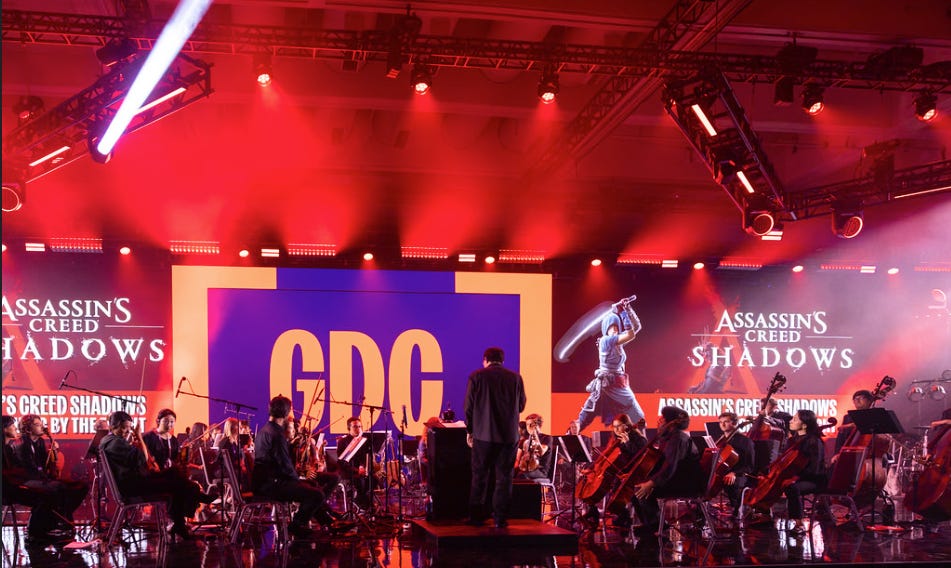
In the gardens outside Moscone, someone was playing piano. Throughout the week I found myself in conversations I didn’t plan and couldn’t have scripted. Developers from Brazil and Argentina bringing their own distinct creative energy and perspective on where things are going. Students from USC, engaging and interested in figuring out how they fit into an industry that is actively reinventing itself. A VR developer from Minneapolis quietly building a VR game while telling me about the heartbreaking conditions there.
An Irishman who literally produced a ring from thin air (a bit of a back story there). A wizard making connections with people with quest badges.

The most energizing conversations I had all week were about new approaches: the friends building new games, friends building new tools, people finding new ways to tell stories that weren’t possible two or three years ago. The tools have changed. The budgets have shrunk. And somehow, in these constraints, people are finding more creative freedom, not less. Creatives continue to find a way to tell their stories. They always have.
Taken individually, each of these encounters was memorable. Taken together, they became something deeper, a woven tapestry of extraordinary talent, drawn from every corner of the world and every corner of the craft. That’s what GDC is, at its best. Not the keynotes or the deal meetings. Not the back-patting old boys clubs or the badge counts. This, this inspiring energy and creativity that you only get when you stop and have individual discussions with people.
What’s My Take Away
For certain, GDC is not what it was at its peak, that is obvious. The industry is in a genuine period of structural change, smaller teams, tighter budgets, real uncertainty about where and how AI fits and who it displaces. None of that disappeared last week.
But creatives continue to find a way to tell their stories. They always have. And what I saw at this show was an industry becoming, perhaps out of necessity, a little more nimble. A little more humble. A little more resourceful. And a little more willing to build something meaningful with less.
The cymbal player on the plane, the pianist in the gardens, an Irishman with a ring, a magician’s quests, they’re not metaphors. They’re the actual people who make this industry what it is. And they were all there.
It was a great reminder for me that it’s important to look a little deeper and move a little slower because sometimes the path less traveled will be the most interesting.